


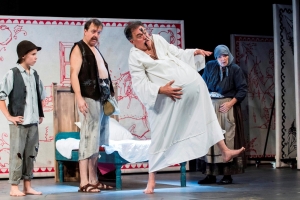
Kecskemétről és Székesfehérvárról is érkezik előadás idén nyáron Újszegedre, a Szegedi Nemzeti Színházzal együttműködésben pedig új bemutatót hoz létre a Szegedi Szabadtéri Játékok a ligetben. A vígjáték-bohózat-komédia hármasa mellett az elmaradhatatlan programok is várják a közönséget.

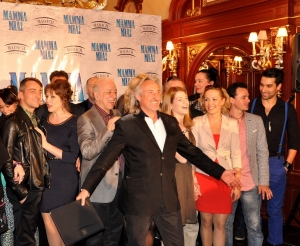
Legyél részese a Madách Színház és a Szegedi Szabadtéri Játékok szuperprodukciójának! Dolgozz népszerű színészekkel és kiváló színházi alkotókkal! Felnőtt statisztákat keresünk a Dóm téri Mamma Mia! musical-produkcióhoz.
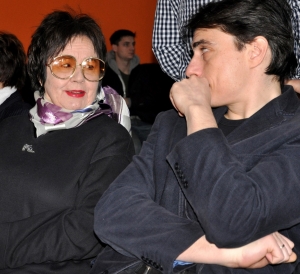

The Iconology of Power. Shakespeare at 450 and the Szeged Open Air Theatre
My talk is inspired by Clifford Geertz's definition of culture which I have developed as follows: "culture is a social practice of multimedial, self-reflexive, and narrative representations by the help of which a community constructs, interprets, and operates its own identity." Identity is inseparable from the ideology and practice of power, while one of the most complex forms of cultural representation is the theatrical performance and its idea, the drama. The stories put on stage are almost entirely about power relations, whether taken from political or private life, ambition, jealousy, competition, love. Different ages have been using different visual means – tradition-based iconology – to vividly represent these power relations. Prompted by the 450th anniversary of Shakespeare's birth, I shall compare the iconology of power in Shakespeare's time with that of the contemporary modern theatre. Here I shall also look at the Shakespeare-stagings during the decades of the Szeged Open Air Theatre (Midsummernight's Dream, 1963; Hamlet, 1967; Romeo and Juliet, 1972; King Lear, 1977; Richárd III, 2002).

Verdi's romantic operas on the Szeged Open Air Festival stage
By the 19th century, the concept of Romanticism had become so widespread that it appeared in all forms of human awareness. In his study titled What is Romanticism?, Friedrich Nietzsche wrote that it was a typically German phenomenon. In his view, the Dionysian spirit was fully developed in the philosophy of Arthur Schopenhauer and the music of Richard Wagner.
In Italian culture, on the other hand, Romanticism was not considered a significant trend, and its dominant characteristics are demonstrated only in music, particularly in Giuseppe Verdi's operas. Verdi regarded Wagner, his rival, with cool respect, but became incensed when he was called the German composer's epigone, an inferior imitator.
Among Verdi's librettos (or the literary works on which they were based) can be found numerous dramatic and poetic sources which are considered by critics as both generally and categorically following the trend to Romanticism. These include such magnus parens – or original source – authors as Shakespeare and Schiller, as well as 19th-century Romantic writers and poets Byron, Hugo, Saavedra and Gutierrez.

Drama magic
In my short contribution as prelude I try to explain the deep common roots of drama and religion. In the second step I will focus on the substantial turn from stage to public, making one parallel with the religious experience interpreted by Victor Turner. In the last step I will show some aspects of the hermeneutical power of drama.

Current operation of the Open Air Festival
Due to its production repertoire, architectural setting and extraordinary atmosphere, the Szeged Open Air Festival is unique in Europe. In a contemporary sense, the Festival is a business enterprise: the high-level attraction draws tourists and brings income to the local service sector, all the while strengthening the city's reputation.
Rediscovery is the central concept in the thinking behind the European festival scene. The general conviction – in cultural policy as well as in the entire theatre profession – is that the courage of the festival director and artistic intention bring about lasting success for music festivals. They boldly present contemporary productions and rediscover forgotten works, even if this comes with a certain risk.
The Szeged Open Air Festival's program offerings are in line with the European trend, while the Festival's management is working hard to find the balance between its cultural mission and the expectations of its actual audience. To this end, continual audience polling has been carried out since 2004, and the results of these polls form the foundation of the Festival's operational strategy.
professor; Department head,
Sociology, Faculty of Arts, University of Szeged

Audience characteristics
The management of the Szeged Open Air Festival has been surveying its audiences for several years. These surveys provide an opportunity to study socio-cultural characteristics of Festival attendees. It has become apparent that a majority of our audience members are women; most attendees hold university degrees; nearly half of our audience members are local residents.
Using the results of other surveys, I have attempted to describe the cultural "patterns" of local residents, particularly the characteristics of cultural consumption and values. I have tried to determine whether these patterns are unique or are similar to those of the Hungarian population as a whole.

Faculty of Arts, University of Miskolc
The City and the University – Intellectual Roots in Kolozsvár
1921 is an important year in the history of Szeged. Almost one hundred years have passed since the Hungarian government transferred Ferencz József University to Szeged, and since that year it has been regarded as a university town.
This lecture will describe the circumstances from the time immediately prior to the occupation of the university, then in Kolozsvár, by the Romanians on 12 May 1919, up to its relocation to Szeged, and the first ten years of its existence there.
Numerous phases of the city's development were connected with the allocation of buildings for the university. Among these, for example, is the Dom Square, which is also home to the Open-Air Festival. The various buildings of the university are integral elements of the Szeged cityscape. In many respects, the placement of the university caused problems in the city, and it took ten years to solve these issues.
In that period, professors who had arrived from Kolozsvár became dominant players in Szeged's public life. The cultural life of the city also became closely tied to the new university's presence.
This lecture will deal with the details of that connection and with the background of the cultural history of the university.