


People's theatre with popular operas
- Rock Operas and musicals at the Dom square –
Popular musical plays are performed at Szeged Open Air Festival since Ferenc Fricsay – whose centenary is to be celebrated this year – conducted János vitéz (Warrior John) by Pongrác Kacsoh first time in 1937. After an American show of West Side Story in 1965 on tour rock operas and musicals finally settled on the stage in 1984 with Stephen, the king. Its success involved many more sensational musical premières at Dóm Square: the first East-European Jesus Christ Superstar in 1986 and the open-air world première of Les Miserables in 1987 gave a new tradition to the festival, which nowadays presents musicals, operas, operettas and rock operas as well every year. The different genres of the contemporary musical shows raise the question: which are the ones of the literature worthy of being played at Klebelsberg's square, on the largest festival scene of Central Europe.

The Beginnings of the Szeged Open Air Festival – Minus the Mythology
The roles of Gyula Juhász, Antal Németh and General Kálmán Shvoy in the establishment of the Open Air theatre
The foundation of the Szeged Open Air theatre festival was for a long time considered the work of Ferenc Hont. However, the concept of putting on performances in the open courtyard adjoining Szeged Cathedral, Dom Square, had already been taken up and even pushed along by Gyula Juhász. And while Hont is regarded historically as the one who dreamed up the theatre under the stars, the reality is a bit more complex than this. Other individuals, now rarely remembered or even completely forgotten, played much more significant roles in the Festival's beginnings than did Hont. It is these individuals and the parts they played that this lecture will discuss.

„Vero e Bello – True and Beautiful"
Verdi operas on stage at the Szeged Open-Air Festival
In the first era of the Festival (1931-39) the choice of plays complied with the sacral trait of the location. Verdi's Requiem was performed in the Dóm in 1938. Then in 1939 Aida was staged. Twenty years later in 1959 the program-politics of the regenerating Festival is labelled by openness and a variety of genres: the presence of dramas, classic and modern ballet, folk dance, operas, operettas, musicals can be observed. Verdi and Puccini operas are performed in huge and spectacular sets. Examining the tendencies it appears that from the international opera literature of the past hundred and fifty years Verdi's works dominate the programs of the open air theatre. After the restart nine of his operas were staged with international participants in the Dóm Square in the course of twenty-one years. Old ways seem to be changing now. The last time we could see Aida was in 2003 and Nabucco in 2005. Moreover, no Verdi opera was put on stage in 2013 in the bicentenary year by the Festival which by all means has a rich history of opera-staging. We are looking for answers to the following questions: is the genre being thrown into the shades? Is the beauty and humanity of the Verdi operas alien to the directors of contemporary theatre and to the audience of the 21st century?

Hungarian operetta on the open air stage of Szeged
The Hungarian operetta appeared on the stage of the newly revived Szeged Open-Air Festival in 1959. János vitéz (John the Hero), the musical drama written by Pográcz Kacsóh was directed by Miklós Szinetár. It was staged by three different directors three more times until 1978.
Another musical drama, Csínom Palkó by Ferenc Farkas, was chosen in 1960 to be performed in front of huge audiences attracted by the Szeged Open-Air Festival probably because it incorporated the events of the War of Independence led by Rákóczi, which was considered to be part of the progressive tradition in Hungarian history. The Hungarian operetta classics were staged only after 1989, the operettas by Imre Kármán and Ferenc Lehár have been on ever since from then on In recent years a formidable workshop of staging and acting operetta has been created by directors Enikő Eszenyi or Róbert Alföldi in Szeged.

Emptiness as Inspiration. The Cathedral and the Cathedral Square in Szeged
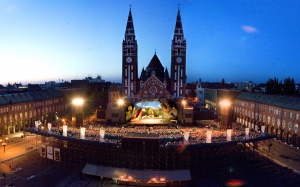
The construction of Cathedral in Szeged and the design of its environment is closely related to the reconstruction after the floods in 1879. The Cathedral can be interpreted as the symbolic centre of a fresh start as well. The Cathedral built according to the plans of Frigyes Schulek and Erno Foerk and the Cathedral Square designed by Bela Rerrich has uniform flanking buildings. The square itself is one of the city's best urban squares because of its generous space and reflects the duality of the city due to its geographical location. On the one hand, the arcades enriched by architectural details evoke the Mediterranean piazzas, on the other hand, the solid brick architecture forms the cooler, northern counterpoint.
These two elements represent the balanced mixture which integrates the square so organically into its environment. The sublime space proportions, the surrounding arcades and the overwhelming Cathedral have made the square one of the most popular locations in the city so far. The renewal of the Cathedral confirms this. The square becomes a stage for urban life.

Votive symbolism of the Szeged Dome and Square
After the flood of 17 March in 1879 the king, Franz Joseph visited Szeged and said Szeged will be more beautiful than before! The citizens of the city decided to build a church as well, the construction of which started in 1913. Nobody suspected at that time that we would be the losers of the world war, nor that a counter-revolutionary government would be formed by Miklós Horthy. All publications about the Dome explain the votive title of the building solely by the flood of 1879, while the church and the square contain many national symbols that are related to elements of the crowning and vow taking ceremonies of the Hungarian kings. The purpose of this lecture is to present the characteristics of the church and the square and to interpret their symbols.
Nem csillapodik a lelkesedés a Mamma Mia! szuperprodukció iránt, a Szegedi Szabadtéri Játékok pedig szeretne a közönség kedvében járni, ezért úgy döntött: ismét plusz előadást iktat be a már most igen népszerű musicalből.