

REÖK content (25)
REÖK STUDIO STAGE OTHER ENTRY TICKETS, DISCOUNTS Tour ticket: 7250 Ft |

REÖK - Regional Art Centre
Art consultant: Dr. Róbert Nátyi, art historian, senior curator
6720 Szeged, Magyar Ede tér 2.
Tel.: +36 62/471-411, +36 62/471-169
Fax: +36 62/471-411
www.reok.hu
Operating organisation:
SZEGEDI NEMZETI SZÍNHÁZ
(National Theatre of Szeged)
Director: Barnák László
Address: 6720 Szeged, Magyar Ede tér 2.
Postal address: 6701 Szeged, Pf. 2260
Tel./Fax: +36-62/471-411
Tel.: +36-62/471-169
E-mail: This email address is being protected from spambots. You need JavaScript enabled to view it.
Web: www.szegediszabadteri.hu
Ticket sales:
On the spot and advance bookings:
REÖK, 6720 Szeged, Magyar Ede tér 2.
T.: +36-62/541-205; +36-62/541-209
Fax: +36-62/541-206;
Opening hours: Tuesday - Sunday: 10-18
Visitors’ House Rules of the Combined Regional Centre of Arts (REÖK)
1. All exhibited works of art are protected by copyright, therefore any forms of disclosure for any purposes are bound to an authorisation which must be requested individually for every piece in each occasion.
2. Reproductions and disclosure authorisations in relation to the works of art may exclusively be requested from the Szeged Open Air Festival and festival Organiser Non-profit Ltd (Szegedi Szabadtéri Játékok és Fesztivál Szervező Nonprofit Kft) operating REÖK.
3. For any reports on the exhibitions and events of REÖK, photos or shooting permit may be requested from the Communication Department ( This email address is being protected from spambots. You need JavaScript enabled to view it.).
4. Food, drinks, bags, coats and umbrellas are prohibited in the exhibition areas. All such items must be placed in the basement cloakroom.
5. We cannot take responsibility for any valuables left unattended.
6. Please disregards the use of mobile phones in the exhibition areas.
7. Bringing animals to the building is prohibited.
8. Smoking is prohibited in the building
9. Bringing flammable or explosive materials is prohibited in the building.
10. Visitors are required to follow the general rules of behaviour.
11. Visitors are required to comply with the instructions of the security service.
12. Dear Visitors, please note that video surveillance and recording systems are in operation in all exhibition areas.
General Information
The transport of the disabled and those in need of help is supported by the lift beside the stairs.
Tickets cannot be exchanged or refunded.
You are entitled to free entry if you can show on demand:
- a press ID card including a photo,
- an International Association of Art card,
- a Nationwide Museum Pass issued by the Ministry,
Further information on discounts can be found under the menu item Tickets.
Opening hours:
Ticket sales
Monday - Sunday: 10-18
Gallery Opening Hours:
Tuesday - Sunday: 10-18
Reök palace – Passion in architecture and arts
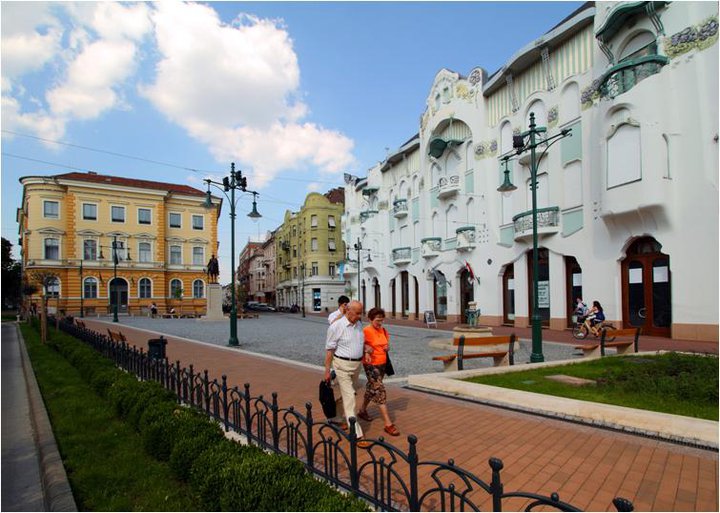
On the corner of Lajos Tisza boulevard and Kölcsey street in Szeged stands one of the most unique works of Hungarian Art Nouveau. Built in the style that foreign literature labels “Hungarian Jugendstil”, the house was designed by Ede Magyar, and completed in 1907. Akin to the residential buildings designed by the Catalan artist Antoni Gaudí, it is one of the most beautiful ones in Europe.

It is indeed a rare treasure that Szeged owns. The family mansion that has been standing in the heart of the city for a century now – resisting wars and changes of the regime – is of outstanding, special value even in European terms. Its builder, Ede Magyar, who died prematurely at the age of 35, was determined, brave and talented enough to defy the conservative Hungarian climate, and connect his hometown to Europe. He brought to Szeged a European development that not only saturated the architecture of the time with its innovative ideas, but also initiated a new approach in other art forms. Although Hungarian architecture at that time already reflected–inSzegedaswell–someelementsofthenew approaches and endeavors, Magyar’s youthful and dedicated energy, his European experience was necessary for the construction of this unique building in Szeged, which seemed bold and surprising, even to the followers of Art Nouveau.

 As Art Nouveau became more and more popular in Europe – opposed to the still flourishingandwidelyaccepted eclecticism – it gained followers in Hungary as well. The work of certain groups or schools (Lechner, Medgyaszay, Károly Kós and the “group of the young”, etc.) is essential to the history of Hungarian architecture. Ödön Lechner (1845–1914) is probably the most widely known and most influentialarchitectofHungarianArtNouveau. He was an innovator of style, and developed the Hungarian formal idiom of Art Nouveau. Although Lechner also worked in Szeged, it is not his influenceone might observe on the design of the Reök palace, but rather that of the French and Belgian Art Nouveau, that Magyar had studied in Paris. This rare school of Hungarian Art Nouveau includes only a few buildings in Budapest – especially those designed by Emil Vidor – and this mansion. Apart from its stylistic innovations, the building is of special value also because it was constructed simultaneously with similar buildings in major European cities.
It was Tibor Bakonyi (1934–1982), an architect living in Szeged, who “discovered” the house in the 1970s. With unflaggingpassionhestudiedthehistory and the past of the house’s designer, Ede Magyar, and of its commissioner, hydraulic engineer Iván Reök (1855–1923).1 Based on Bakonyi’s research we will present a short history of the builder and the commissioner, as well as give a description of the building (Tibor Bakonyi: Ede Magyar. Gyorsjelentés Kiadó, Budapest, 1995, translated by Tamás Érdi).
Ede Magyar was born at Orosháza, on 31 January, 1887. He was the third child of the family and three years old when the family assumed the surname Magyar. In 1901 Ede Magyar obtained his qualificationas master-builder in the Budapest State College for builders. During his student years he made several trips abroad. Paris was his favorite destination.

After his study trips he mainly worked in Szeged. In the years following the turn of the century, the building industry was still flourishingasaresultoftheeconomic prosperity following the Austrian–Hungarian compromise of 1867, so Ede Magyar embarked on his career at a fortunate time. His work as an architect is known from 1904. He was twenty-nine when he was commissioned to design the Reök palace. Even today it is considered a rare opportunity for an architect to be commissioned by a fellow countryman who not only shares the same views, but also trusts him to such an extent that he can carry out his ideas with full devotion and passion.
Authorization plans for the building were submitted on 2 July, 1906 to the Committee for City Architecture. The submitted drawings almost entirely correspond to the actual ground plan of the building, although the drawings, while truly reflectingfenestrationandthe doors, demonstrated neo-Baroque details and articulated parts of the façade.2 The building was completed to exacting standards in November 1907, in only one and a half years, mostly with the collaboration of local artists and artisans. The plan of the house reflectsthe requirements of the commissioning family: Iván Reök asked for a bachelor flatoneachstoreyforeachofhistwosons, and two-two flatswithmoreroomsoneachstoreyfor his daughters. The grouping of the flatsandtheirlayout are up to date and even ingenious. On the ground floorcornerarestaurantwasopened,whiletherestofthespaceswererentedby craftsmen and shopkeepers. To the left of the entrance Ede Magyar set up his own architectural studio.

The small square in front of the Reök palace adds to the cityscape effect of the building. The supple elevations of this three-storey corner house, shaped by almost sculptural means, excite the curiosity of the spectator from far away. The most emphasized part of the main façade is the corner, markedly articulated by balconies, bay windows and the high crenellation. The undulating walls, its magical flower-shapedornamentsmake it diverse, but being in complete unity with the architectural tectonics, also suggest balance. The rhythm of the façade’s articulation is remarkably ingenious, too: it emphasizes the main entrance and the corner turning simultaneously (Bakonyi 1995:17).
Magyar’s daring and freshness, the richness of ornament, the overall symbolism still to be deciphered evokes admiration and amazement even today. We agree with the statement of his enthusiastic researcher, Bakonyi, that such perfection of form, transubstantiation of floraldesign into structural elements, such exquisite modeling of pilaster- and column capitals transformed from floraldecorationsisallbutmatchless in the Art Nouveau movement. (Bakonyi 1995:18) Magyar’s associate, János Takács, recalls very accurately the circumstances of the building’s unusual modelling:
“The undulating shape of the walls is essential. The façade is comparable to a relief picturing the serene tranquillity of a lakeside, avoiding distinct lines. Bow windows with their soft shadows, the swelling supports of the balconies, the undulating forms of the pilaster strips, column shafts and gables, all these are composed of motifs of water-weed adapting themselves to a water-side scenery.” (Bakonyi 1995:19)

The panels under the overhanging cornice had been decorated with seccoes of water-nymphs, however, the more conservative ladies of the family soon let them be scraped off. On the interior of the building Bakonyi passionately writes:
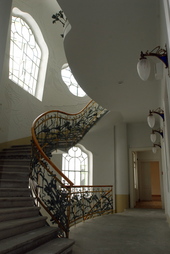
“The stylized vegetable details applied to the front continue in the staircase. The creeper pattern springing from the root runs up on the wrought iron rod and bursts into a flower.Onthegrid-panelslilies, budding and full-blown, can be seen, giving an upward throbbing, spinning impression. A glance in the stair well reveals full-blown lilies everywhere, and this makes communication in the staircase in every direction a delightful experience. The wrought iron works of rare beauty on the building were made by Pál Fekete after Ede Magyar’s drawings. Pál Fekete (1873–1908) a Szeged metal-worker artist-craftsman, was one of the domestic masters of smithcraft blessed with fineformalinvention.

Every window of the staircase has a distinct subdivision, the thin saddle bars suggest floraldecorations.Theupward-swellingcalligraphies of the repeated strapwork-components, running along the stairs, add to the magic of the staircase.” (Bakonyi 1995:20)
Bakonyi suggests that the two horse-heads above the main entrance, composed into the tympanum, are an allusion to the owner’s horse-breeding hobby, while the bird on top of the corner refers to the one-time Fekete Sas (Black Eagle) street. By creating the Reök mansion in Szeged, Ede Magyar established his reputation. Now he received one commission after the other. In 1909 he won a national competition to design the Kaposvár theatre, accommodating 1400 people. The building began in January 1910, and already in April 1911 the reinforced concrete structure was tested. Contemporary press reported the inauguration of the building on 2 September as “A masterpiece of Szeged architects”.
Ede Magyar died prematurely, shooting himself on 5 May, 1912. Some more of his works that should be mentioned are: Schäffer palace, Szeged (1904–5); Presbyterian church, Nagykikinda (around 1908); Unger–Mayer house, Szeged, (1910–11); Palace of the Reformed church, Szeged (1910– 12); Simon palace, Hódmezôvásárhely (1912–13).

His tragically short but nonetheless important oeuvre places Magyar among the most outstanding architects of Hungarian Art Nouveau. He is among those artists who immediately adopted the new spirit and the ideas, the modern approach as the new trends developed in Europe. The characteristic modelling of the Reök palace is unique in Hungary. Its composi-tional methods and plastic inventions are matchless in Europe as well. Art Nouveau, in architecture as well as in applied arts, brought content and form closer to each other, and resulted in a new stylistic unity. Designing either articles for everyday use, or buildings, the starting point was function, which was then modelled after forms found in nature, in the floralworld.Specialistsofthehistoryofarchitecturetracebackthearchitectural forms of Art Nouveau to the paintings of William Blake (1757–1827). Bakonyi cites an article by the British art historian of Irish origin, Edwin Johnston, on Magyar’s building:
“The enormous curvilinear balconies and the vegetable details meet at the projection of the street corner in an irregular jaw frontispiece, which is a remote image of William Blake’s God Almighty.” (Bakonyi 1995:17)

One of the most interesting, most original artists of Art Nouveau was the Catalan architect Antoni Gaudí (1852–1926), who made the best of the workings of fantasy. Indeed, the Reök palace might call his famous Barcelona buildings to mind, the Casa Batlló or the Casa Milà, built around the same time as the building in Szeged. One findssimilaritiesboth in the façade and in the details of the interiors. Both Magyar and Gaudí owe much to the buildings designed by the Brussels architect Victor Horta. His well-known building in Brussels, the Tassel palace (1893) could have been their model, or the special spatial design, and the details of the lobby and the staircases in Horta’s own house, built in 1898–1900. As a French inspiration we need to mention here Hector Guimard (1867–1942), who exerted great influenceonhis contemporaries through his best known works for the 1900 World Exhibition, such as the famous entrances to the Metro stations in Paris and his ornate staircases. Both Horta and Guimard use expressive forms, rich details, and dynamic surfaces.

The Reök Palace in 1923
In the second part of the 20th century the Reök palace has undergone several reconstructions and renovations, but luckily, these did not diminish the value of the building or make irreversible alterations. After recent renovations, the former city palace reveals even more of its merits. Now not only the ground floorspaces,buttheupperfloorsarealsoopentothepublic.Therenovatedpalace will become a new venue for the art-loving public of Szeged. The hundred-year-old Art Nouveau palace opens its doors in August 2007. Tamás Herczeg, director of Reök, a former inhabitant of the building launches the program series in there with the same passion that characterized the creators of the palace. The Reök palace – Regional Arts Centre will try to fulfillmultifunctionalculturalpurposes, such as hosting the city’s art gallery. It opens with the exhibition “Beauty and Pain”.
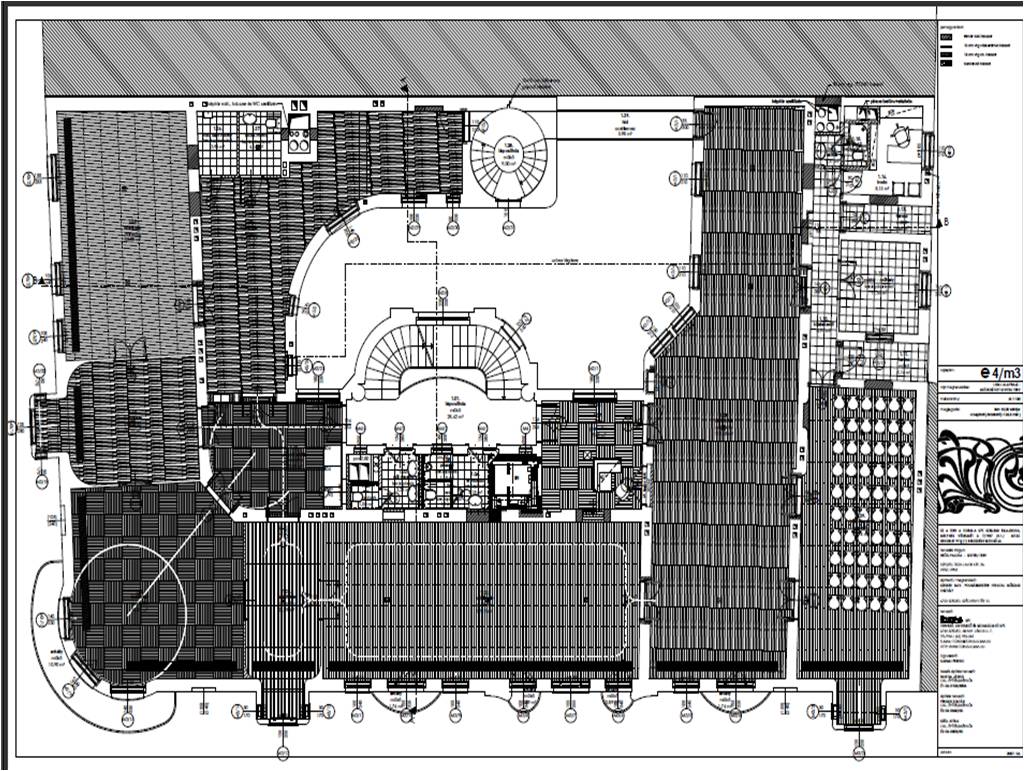
Kiállítási területek alaprajzai és műszaki adatok
I. emelet

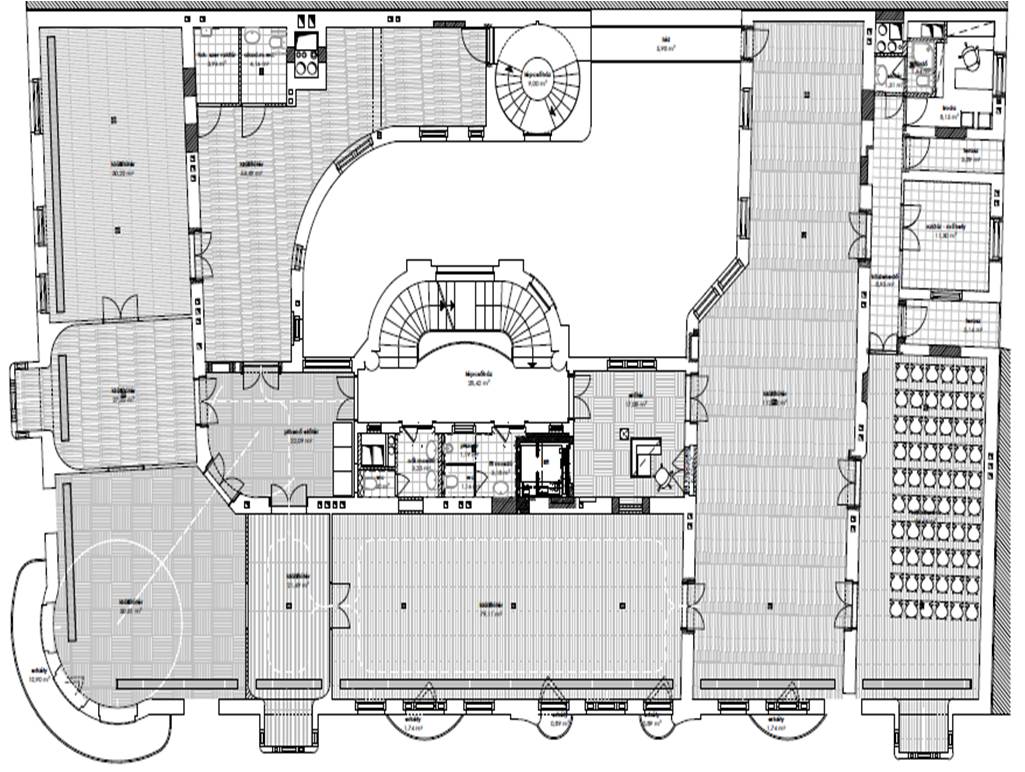
II. emelet
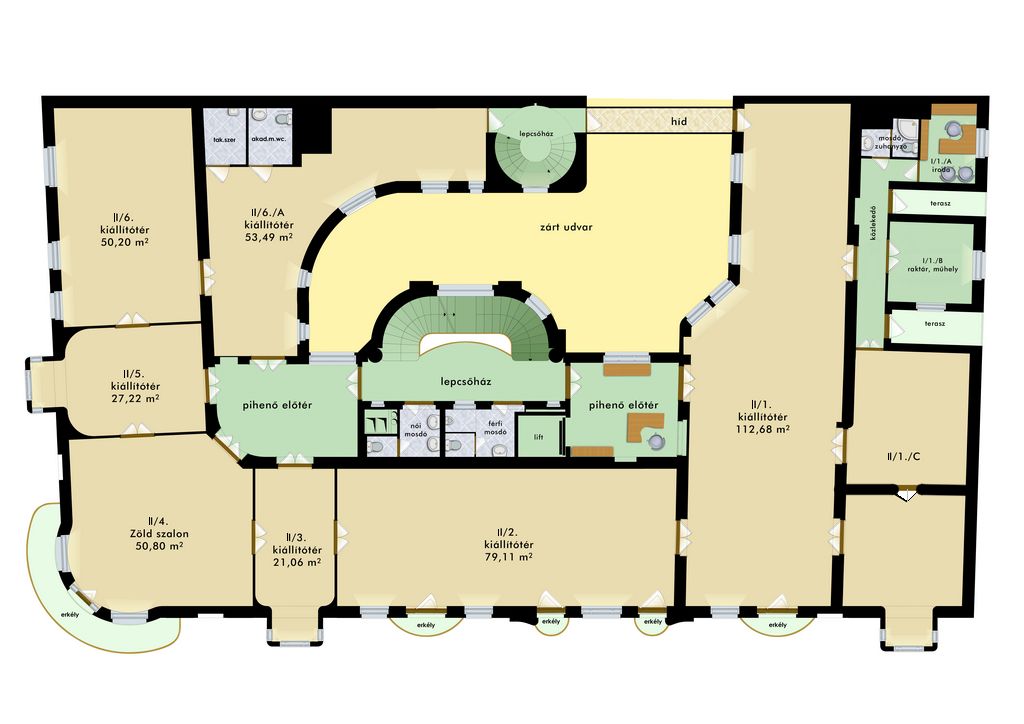
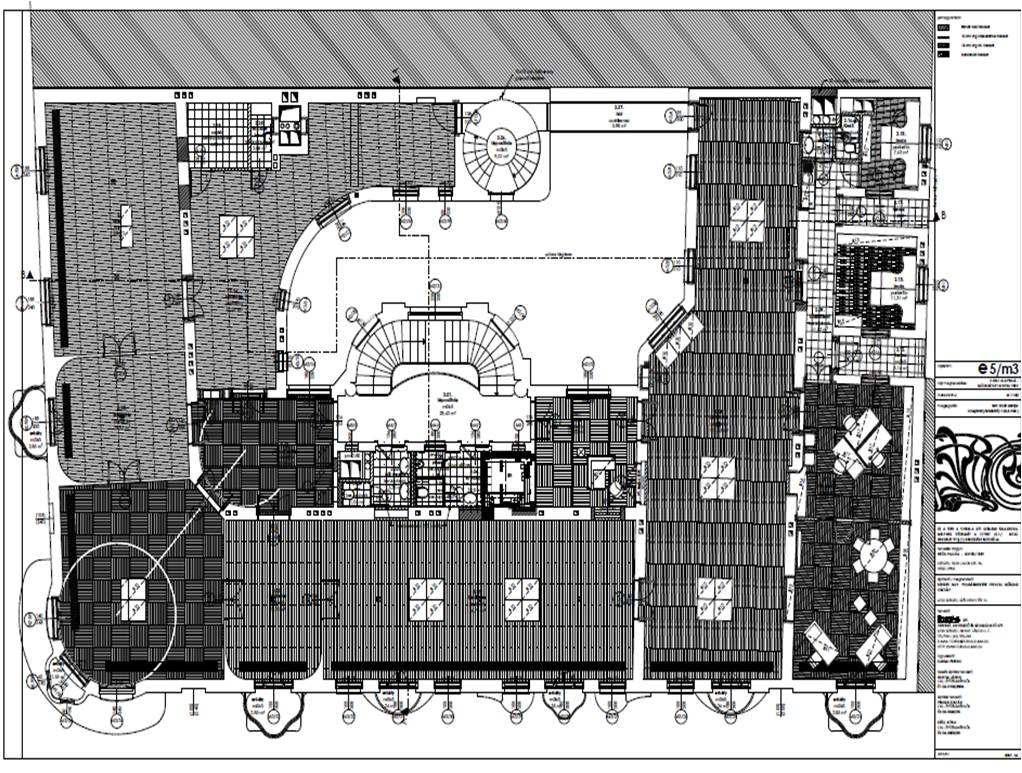
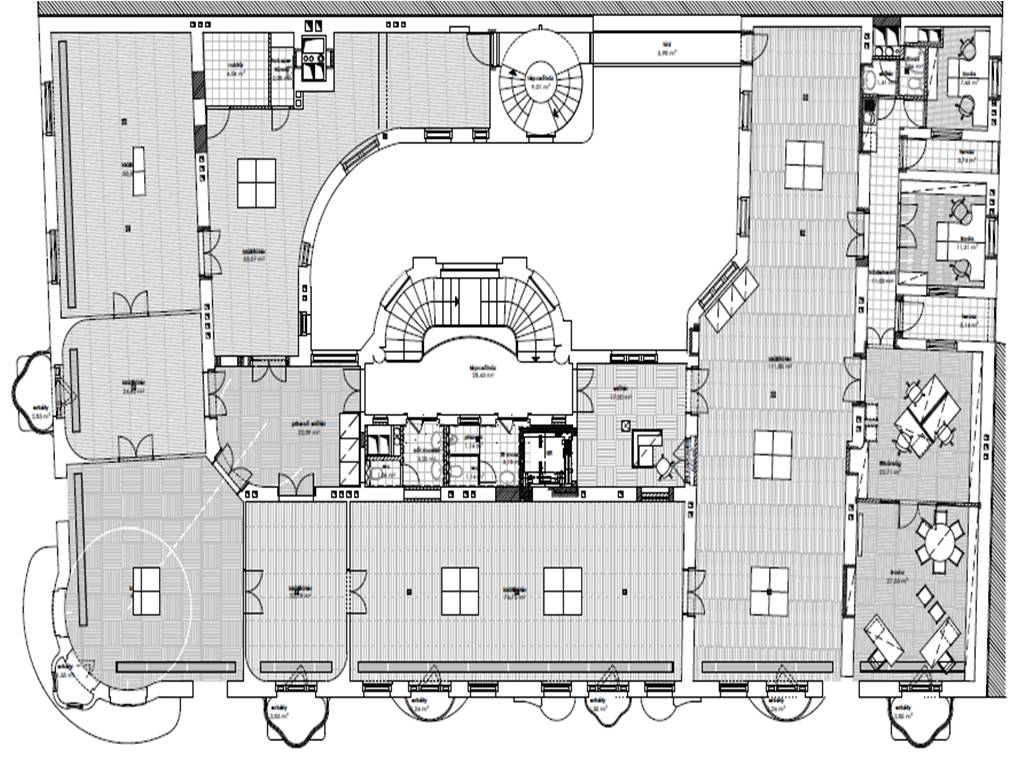
Kiállítóterület
• fedett udvar: .. .. .. .. .. .. .. .. .. .. .. .. .. ..91,30 m2
• I. emelet műtárgyraktárral: . .. .. .. .. .. ...400,07 m2
• II. emelet: . .. .. .. .. .. .. .. .. .. .. .. .. .. ...384,93 m2
• összesen:.. .. .. .. .. .. .. .. .. .. .. .. .. .. ....785,00 m2
Kiállítófelület
• I. emelet különteremmel: . .. .. .. .. .. .. ..149,3 fm
• II. emelet: . .. .. .. .. .. .. .. .. .. .. .. .. .. . 141,15 fm
• összesen:.. .. .. .. .. .. .. .. .. .. .. .. .. .. ...1016,57 m2
(3,50 m-es magassággal számolva)
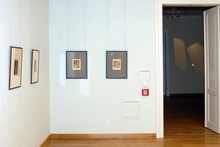
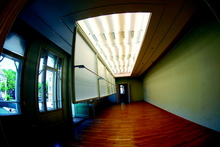
Világítási konepció
A kiállítótermekben az egyenletes és káprázástól, valamint zavaró ref-
lexióktól mentes világítás létesítéséhez az általános világítást nagyfelületű
világító berendezések (világító mennyezet) biztosítják, egyes tárgyak
kiemelő világításhoz sínes világítási rendszer áll rendelkezésre.
1. Nagyfelületű világító berendezés
• fényerőszabályzásra alkalmas elektronikus előtéttel üzemeltett
fénycsövek
• extrudált alumínium profilból méretregyártott, kiemelhető keretbe feszített, transzlucens, opál-fóliával borított világító felület
2. Sínes világítás
• minden kiállításhoz egyedileg installálható
• szükség szerint a kiállítás látogatóinak mozgását érzékelve vagy egy
időprogram szerint változtatja a fényerőt, a világítás színét stb.
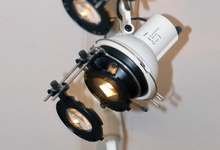
• sínre szerelhető lámpák típusa:
ERCO halogén kiemelő lámpa 100w flood
ERCO Optec halogén falmosó lámpa 75W
Erco Pollux halogén lámpa 50W
Gyengeáramú hálózatok
• telefonhálózat
• számítógép hálózat
• tűzjelző hálózat
• vagyonvédelmi hálózat
• videomegfigyelőrendszer
• hangosítás
Szellőzés és légtechnika
• óránként háromszoros légcsere a kiállító helyiségekben
• télen-nyáron 20 °C-os (+- 5 °C) levegőbefújás
• télen-nyáron 50% (+- 5 %) relatív páratartalmú levegő biztosítása
Tegyen virtuális látogatást a REÖK-ben! A webséta során szétnézhet a csodaszép szecessziós épület kiállítótermeiben, és megtekintheti a tárlat festményei.
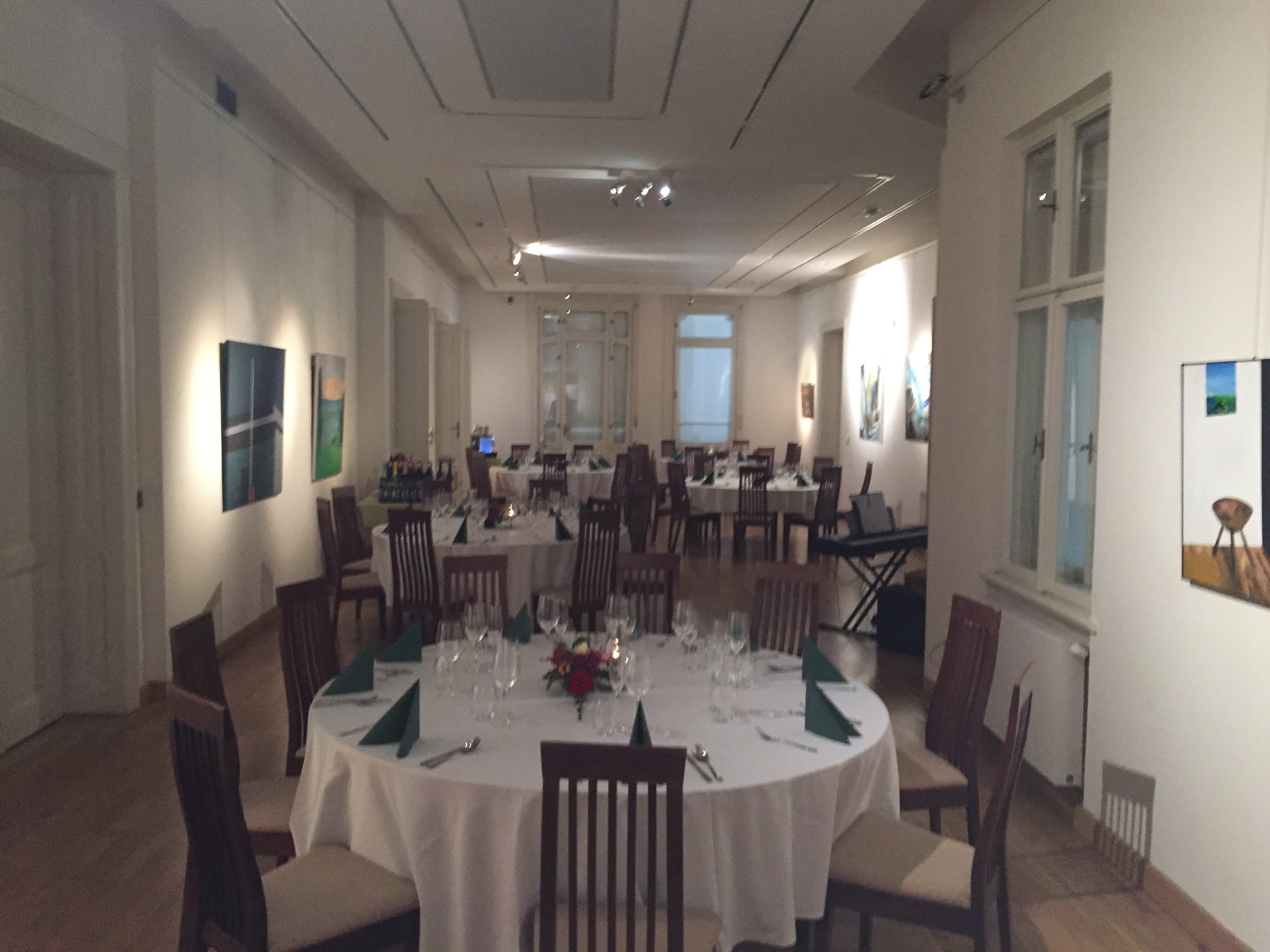
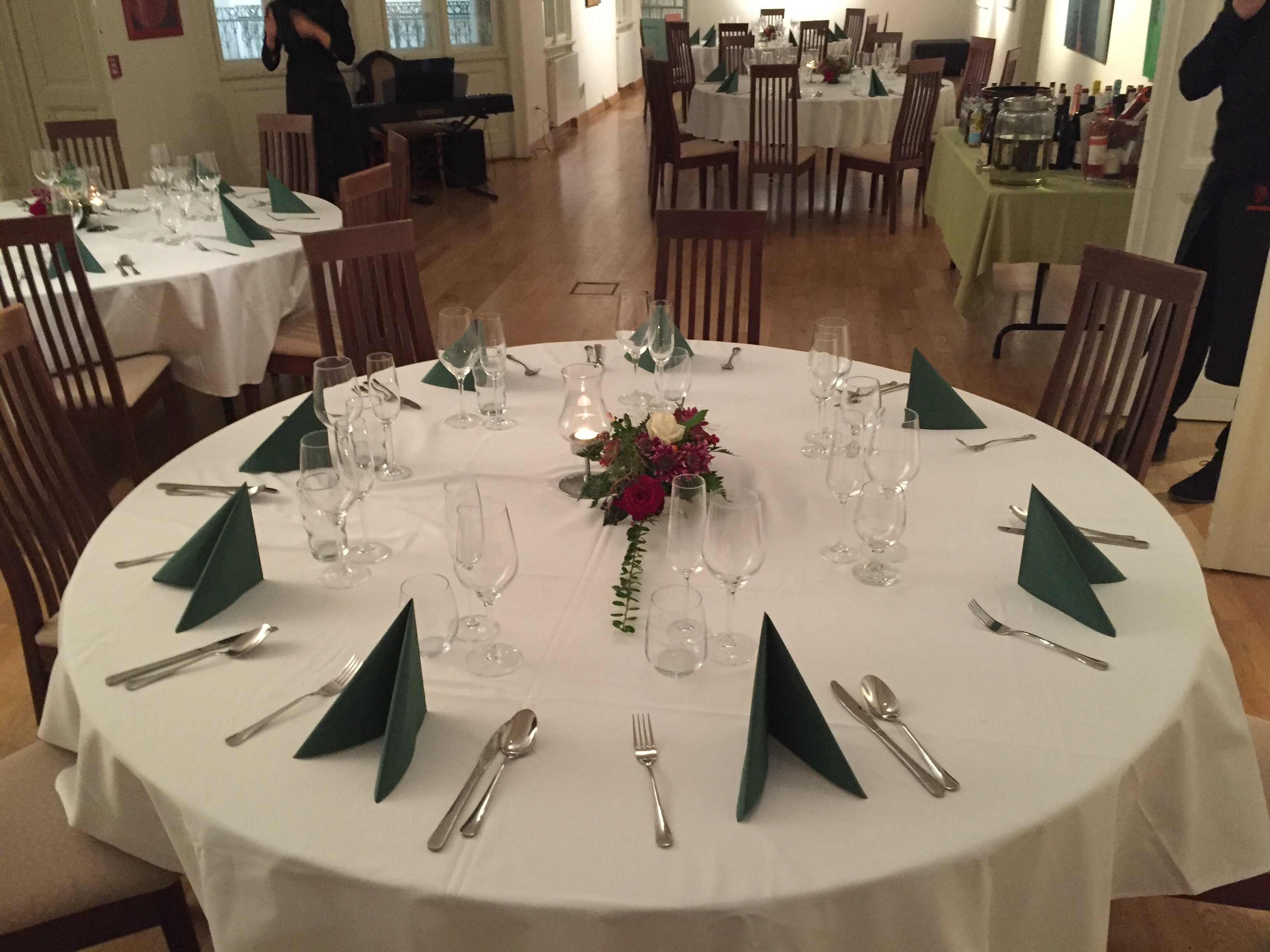
The renewed Reök Palace is an outstanding built heritage of the Europa Nostra Prize winner town, Szeged. The environment of the Palace recalling the world of salons of the first few years of the previous century provides an exceptional location for events, receptions and conferences.
The exterior beauty of the building is worthily complemented by the fact that such events can take place betwixt works of fine arts.
For further information please contact us at the tThis email address is being protected from spambots. You need JavaScript enabled to view it. e-mail address.
Photos of the Building>> Ground-plan, technical parameters >>
Planned exhibitions in 2020
DancingArt

December 6 2019 - January 19 2020
DancingArt exhibition by contemporary photographers! Opening
ceremony  on December 6 at Reök Palace. DancingArt works from
ballet to folk dance to many variations of contemporary dance
are on display. The  portrayal of dance has fascinated artists
since ancient times, for a momentous, volatile moment has to
be captured for eternity.  Pictures from the REÖK and MANK
collective exhibition show the different emotions and moods
of a total of 45 photographers on the  walls, capturing the
energy of steps and gestures as accurately as possible. The
exhibition of over 70 images will be available until January
19th. We warmly welcome all of you who are interested!
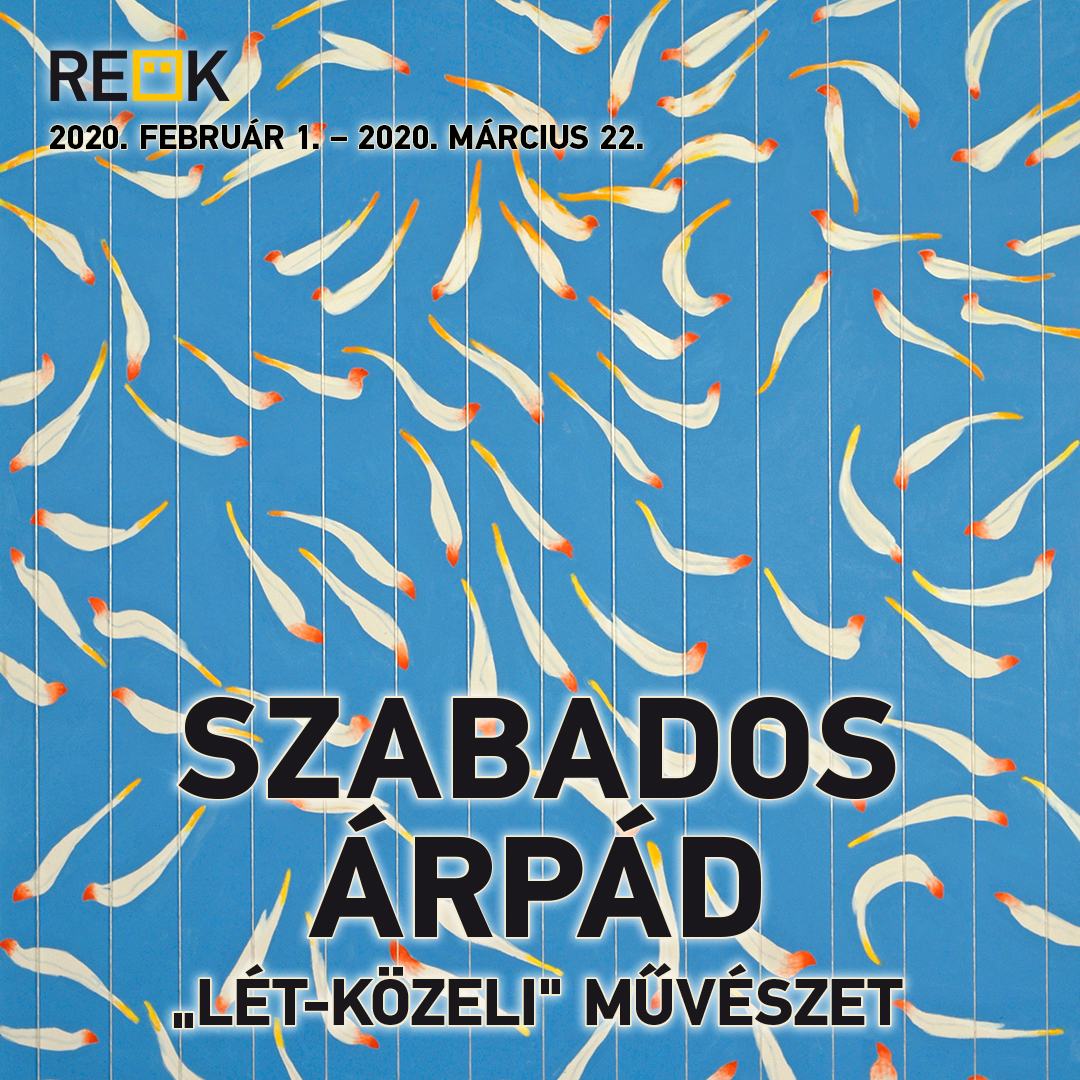
"Lét-közeli" művészet

February 1 - March 22.

Árpád Szabados- painter and graphic artist- has a great
career. The early stages of his art were characterized
by expressive works with strong emotional expressive power,
followed by surrealistic elements,the bordering, split
composition. The exhibition in REÖK shows more than 200
works by Árpád Szabados on two floors of the palace.
His works include paintings, graphics and linocuts.
Exhibition of Gabor Nagy
Gábor Nagy is a painter and graphic artist, who graduated
from the Hungarian Academy of Fine Arts in 1973. In the 1970s,
he belonged to a group of early-stage painters who looking for
possible answers to new questions in painting as well.
Among other things, he was looking for a balance between
color and artistry. He also makes small wood sculptures;
newer sculptures are thematically related to pictures and drawings.

XVIII. Biennial
One of the most prestigious fine arts events of the summer
in Szeged is a cross-section of Hungarian contemporary painting.
The Army Review aims to provide a comprehensive and
credible picture of domestic panel painting, in a freelance
system, featuring works selected by the jury. For the seventh time,
the Reök Palace will host the high-profile event.
Exhibiton of Aatoth Franyó
July 24 - September 20.

The title is an important element of Tóth István's
(his artist name is AA Tóth Franyó) pictures.
The objects, creatures depicted have a symbolic meaning,
so the horses following each other endlessly,
represent the monotonous passing of time, while empty chair
is a symbol of power. He was born in Nyíregyháza,
mostly responds to current events and criticizes people
and society of his age with scornful works. In addition
to his paintings, he has also significant graphis works.
Exhibition of the Artist's Colony of Szeged
July 24- August 31
For more than two decades, the Artist's Colony of Szeged
has been the venue of hungarian contemporary artists to
present themselves. The list of participating artists shows
well-known names not only in Hungary, but also abroad.
From the very beggining- thanks to the progressive approach
of the Artists Colony- you can see famous artists's works
and beginner artists's work as well.
7 August - 20 October
Curator: Katalin Papp
CONTEMPORARY SZEGED I.
17 August - 30 September
Curator: Robert Natyi
LÁSZLÓ FELUGOSSY’S EXHIBITION
3 October - 21 October
Curator: Robert Natyi
PÉTER NÁDAS’ PHOTO EXHIBITION
5 October - 21 October
HUNGARIAN NATIONAL PAINTING DAY
15 October - 30 October
ESZTER CSURKA’S EXHIBITION
25 October - 7 November
25th HUNGARIAN PRESS PHOTO EXHIBITION
2 November - 2 December
-NATIONAL GEOGRAPHIC INTERNATIONAL - international selection